Equality for All: Anti-Trans Discrimination and the Supreme Court
Fairness should mean that everyone gets a chance to play.
By Tekla Taylor
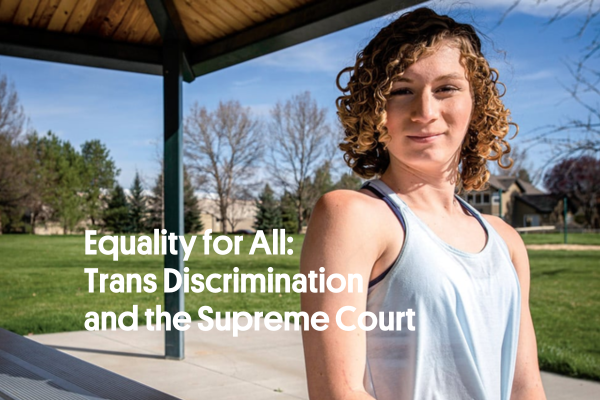
As anti-trans extremists try to force rigid gender stereotypes onto all Americans, politicians have targeted trans children’s ability to participate in sports, denying them equal access to a free and safe education. These politicians, and their allies in right-wing media, have used the idea of trans youth simply existing and playing sports with their friends to attack the whole concept of equal rights for all—and the ability of trans people to participate in all parts of life.
Extremists claim that excluding trans youth from sports is about “fairness”—but forbidding some young people from participating just like everyone else is the definition of unfair. These exclusions deprive trans children of their basic human dignity and their ability to participate in the same educational and athletic programming as every other child. And these same anti-trans extremists and politicians seek to eliminate trans people's ability to seek gainful employment, housing, access to public accommodations, and healthcare.
Fairness should mean that everyone gets a chance to play.
Two cases before the Supreme Court—Little v. Hecox and BPJ v. West Virginia—get at this basic question of fairness. In these cases, which will be heard together in front of the Court, one young trans girl and one young trans woman ask to be allowed to participate fully. BPJ, a young trans girl, says being prohibited from playing the sport she loves violates the landmark civil rights law known as Title IX, and college athlete Lindsay Hecox asks to be protected from this discrimination under the Equal Protection Clause of the Fourteenth Amendment.
What is Title IX?
Congress enacted Title IX in 1972. Feminists fought for Title IX because girls and women were denied equal opportunities in education. Shortly afterward, federal regulations based on the law allowed schools to provide more equal opportunities for girls and women.
Sports are an essential part of education—and an important part of growing up. We know that sports participation improves academic outcomes and allows children to build healthy relationships with their peers. Through sports, children learn values like teamwork, leadership, strategic thinking, and self-discipline. They encourage children to find the joy of movement. Everyone deserves that. Title IX enables everyone, regardless of their sex, to participate equally in any educational activities that are funded by the federal government.
As Auden Perino writes, “Title IX was drafted to expand opportunities for all students, instead of shutting students out of activities based on outdated, harmful stereotypes about our genders and bodies. For generations, femininity was wrongly equated with being smaller, weaker, and less competitive.” This white, Eurocentric standard of femininity is particularly harmful to Black and Brown women, whom others frequently cast as “overly strong” or “manly.” For example, Tidye Pickett and Louise Stokes, the first two Black women to represent the U.S. in the 1936 Olympics, were grossly described in the press as unfairly advantaged “hermaphrodites.” Intersex people have also been excluded from sports and had their bodies unfairly scrutinized. Now, politicians and anti-trans extremists use these same stereotypes about who women are and what they can do to justify the harmful exclusion of trans girls and women.
In addition to demonstrating that Title IX protects trans students’ ability to participate in sports alongside their peers, A4TE submitted a brief to the Court demonstrating trans people have suffered a long history of de jure discrimination, which is illegal under the United States Constitution.
What is de jure discrimination?
De jure discrimination, which is Latin for “by law,” refers to discrimination that is written into the law or decreed by the courts: that is, official discrimination. Jim Crow laws, which mandated racial segregation and discrimination from the late 19th to the mid-20th centuries, exemplify this kind of discrimination.
In December 2024, during the US v. Skrmetti case, Justice Amy Coney Barrett asked if trans people had faced this kind of discrimination before. Trans attorney Chase Strangio answered that yes, we have. Centuries of laws against publicly wearing clothes that don’t match our assigned sex at birth are just one major example.
Just like everyone else, trans people are protected under the Fourteenth Amendment’s Equal Protection Clause, one of the Constitution’s most powerful guarantees that everyone should have equality under the law. Adopted into the Constitution after the Civil War, as formerly enslaved Black people fought to live as free and equal citizens, the Equal Protection Clause has two fundamental principles: equality and protection.
“States must protect people from violence and other legal wrongs; provide access to courts; protect rights essential to life, liberty, property, and happiness; and provide goods and services, such as education, on an equal basis.” – Constitutional scholar David H. Gans
Does the law discriminate against trans people?
Trans people have long faced discrimination under the law. We must be allowed to fully participate in public life, and it is acceptable to deny us the same opportunities that everyone else has.
The American story is full of people who demanded that they, too, should be protected under the law.
The Fourteenth Amendment exists because newly emancipated Black people urgently needed protection from discriminatory state governments after the Civil War. And feminists fought for the Nineteenth Amendment so that women could fully participate in public life as voters.
History demonstrates the government has long used our legal system to persecute transgender people. For centuries, people who lived outside of traditional gendered expectations and overly broad assumptions about sex were regularly prosecuted, forcibly institutionalized, and incarcerated. This was particularly true for Black trans people like Frances Thompson, who bravely testified to Congress in 1866 that she had been attacked and sexually assaulted by a group of white men. Her story was widely publicized in the press, and the committee investigating these outrages against Black people in the South “made a particular point of her testimony.” Ten years later, she was arrested for “cross-dressing,” forcibly examined by doctors, and sentenced to imprisonment—even though she said that she had been “regarded always as a woman."
And in the late 19th century, trans man Joseph Lobdell was forced into an institution just because he wore men’s clothes and rejected a traditionally feminine role.
Beginning in the 1840s, many states enacted laws expressly prohibiting “wearing a dress not belonging to his or her sex,” while others used vague restrictions to prosecute people for wearing gender non-conforming clothes, such as New York’s law prohibiting “disguises” and California’s law prohibiting “masquerading.” In practice, these laws were used to police people’s appearance and harm people who didn’t conform to the “correct” gender presentation. Trans people were constantly harassed and arrested simply for being themselves.
In 20th century American cities, law enforcement raided and closed hundreds of businesses frequented by LGBTQI+ people, using every tool available to punish queer and trans people for existing in public. Police harassment was both constant and invasive. In 1973, Chicago police forced two trans women to remove their clothes and be photographed to “prove” that the clothes they wore were illegal just because of the sex they were assigned at birth.
And in the 1980s, as visibility of trans people increased in society, federal legislators began to insert language into nondiscrimination statues that excluded trans people, denying our community much-needed protections under fair housing and disability laws.
Clearly, trans people in the United States have suffered a painful and persistent “longstanding pattern of discrimination." For decades, anyone who openly lived outside of strict gender norms was at risk of imprisonment and barred from many forms of employment.
Trans advocate and writer Holly Boswell, one of the first to use the term “transgender,” wrote in 1994 that “we have been persecuted [...] by the same people who try to shape humanity to their own image, denying our right to be ourselves so they can maintain their power.” We are still fighting this deep, ongoing injustice as we try to access the same opportunities as everyone else. We deserve so much better.
As trans people, we must be able to live freely and openly in society—and the Constitution’s guarantee of equal protection includes us.


Stay Informed
Subscribe to our newsletter to get the latest news and opportunities for action delivered straight to your inbox.
Subscribe